

Teeth that appear smaller than average can affect the overall balance of your smile, and veneers are one approach a dentist may consider to address this. Whether the concern involves width, length, or shape, cosmetic dental treatments vary in approach depending on the underlying cause and your oral health.
Understanding what the process involves and whether you are a suitable candidate is worth doing before committing to treatment.
Quick Overview
- Dental veneers are thin, custom-made shells bonded to the front surface of teeth that may add length or width to teeth that appear small.
- They are often considered by people with naturally small teeth, worn tooth edges, or narrow tooth shape, provided oral health is sound.
- Both porcelain and composite veneer options exist, each with different preparation requirements, cost, and longevity.
- Individual outcomes depend on tooth structure, material choice, and whether additional factors such as excess gum tissue are present.
Below, we explain what causes teeth to appear small, which veneer types may apply, and what to consider before treatment.
What Causes Teeth to Appear Small?
Understanding why teeth appear small matters, as the cause influences which treatment options are appropriate.
Some teeth are naturally smaller than average, a condition known as microdontia. Peg lateral incisors, a variation found in the upper front row, are narrow and can create uneven spacing alongside adjacent teeth. In other cases, teeth may have worn down over time due to grinding or acid erosion, reducing their original height and width.
Teeth can also appear small when excess gum tissue covers part of the visible surface. In these cases, a dentist may assess whether the gum line is a contributing factor before recommending veneers, as veneers address the visible tooth surface rather than the surrounding gum tissue.
How Veneers Can Address Small Teeth
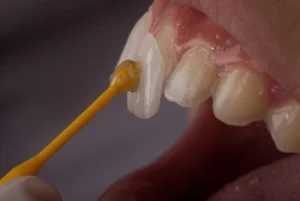 Veneers are thin shells bonded to the front surface of a tooth. When teeth are small, veneers can be designed to add length, width, or both, producing a more proportionate result relative to adjacent teeth and facial features.
Custom veneers are shaped to work with each patient’s facial proportions rather than following a standard size. Digital smile design tools allow the dentist to plan veneer dimensions before any preparation begins, supporting a more considered approach to the proposed outcome.
Individual outcomes vary depending on the degree of size difference, tooth position, and the available tooth structure for bonding.
Porcelain or Composite: Which Suits Small Teeth?
Two main materials are used for veneers in cosmetic dentistry: porcelain and composite resin.
Porcelain veneers are fabricated in a dental laboratory and bonded at a second appointment. They are associated with greater durability and stain resistance. Like all dental restorations, veneers require careful ongoing care to maintain their appearance and function over time.
Composite veneers are applied directly to the tooth in a single visit and generally require less enamel removal. This can be an advantage where preserving tooth structure is a priority, particularly for teeth that are already small. Composite is more prone to staining over time and may need replacing sooner than porcelain.
At Sydney Laser Dental Care, CEREC technology allows porcelain veneers to be designed and milled in-house in a single visit. For very small teeth, minimal-prep or no-prep veneer options may also be discussed where appropriate.
Who May Be a Suitable Candidate?
Not everyone with small teeth is a straightforward candidate for veneers, and a dental assessment is the appropriate starting point.
Veneers are generally suited to people with healthy gums and no active tooth decay. It is important to have a full dental assessment first before any cosmetic treatment is planned, as existing dental problems need to be addressed beforehand.
Patients who grind their teeth may face a higher risk of veneer fracture. A dentist will factor grinding habits into any treatment recommendation, and a protective occlusal splint may be advised in some cases.
If excess gum tissue is contributing to the appearance of small teeth, a dentist may also discuss whether tissue-related treatment is appropriate alongside or before veneers.
How to Care for Veneers on Small Teeth
After veneer placement, the underlying tooth and gum tissue remain susceptible to decay and gum disease. Consistent care is important for maintaining the condition and longevity of the veneers.
Practical steps include:
- Brushing twice daily with a soft-bristled toothbrush and non-abrasive toothpaste
- Flossing daily along the gumline around each veneer
- Avoiding biting directly into very hard foods with veneered teeth
- Wearing a protective occlusal splint at night if your dentist has recommended one
- Attending dental check-ups at the intervals your dentist advises
A Considered Approach to Veneers for Small Teeth
 Veneers can be a suitable option for people with small teeth, provided oral health is established and treatment is planned around individual anatomy. Material choice, the degree of preparation required, and ongoing maintenance all form part of that decision.
At Sydney Laser Dental Care, our team carries out a thorough assessment of each patient’s oral health before cosmetic options are discussed across our three clinics in Pyrmont, Illawong, and Sylvania Waters.
If you would like to discuss whether veneers may be appropriate for your situation, we welcome you to get in touch with the clinic nearest to you.
- Illawong: (02) 9158 6756
- Sylvania Waters: (02) 9159 6083
- Pyrmont: (02) 9158 6213
Frequently Asked Questions
Can veneers make small teeth look larger?
Veneers can be shaped to add length and width to teeth that appear small, creating a more proportionate result alongside adjacent teeth. The degree of change depends on existing tooth structure, material chosen, and how each veneer is proportioned relative to the face. A dentist will assess what is appropriate for your individual situation.
Do veneers on small teeth require enamel removal?
Traditional porcelain veneers involve removing a small amount of enamel so the veneer sits flush with surrounding teeth. For teeth that are already small, composite or minimal-prep options may reduce the amount of enamel affected. A dentist will explain which approach suits your tooth structure before any preparation begins.
Note: Any surgical or invasive procedure carries risks. Before proceeding, you should seek a second opinion from an appropriately qualified health practitioner.
References
Healthdirect Australia. (2025). ‘Veneers’. Healthdirect Australia, 17 June. Sydney, NSW: Healthdirect Australia. https://www.healthdirect.gov.au/veneers
Australian Dental Association. (n.d.). ‘Crowns, Bridges and Veneers’. Teeth.org.au. Sydney, NSW: Australian Dental Association. https://teeth.org.au/crowns-bridges-and-veneers
Department of Health & Human Services. (n.d.). ‘Cosmetic dentistry and teeth whitening’. Better Health Channel. Melbourne, VIC: Victorian Government. https://www.betterhealth.vic.gov.au/health/conditionsandtreatments/cosmetic-dentistry-and-teeth-whitening


